


Author: Matthew Wells, DO
Introduction
Bone and soft tissue tumors can be different in size, shape, and how they behave. Some tumors are benign, which means they are not cancer. Some of these tumors often grow slowly and may never cause serious problems. Other tumors are malignant, which means they are cancer and may grow more quickly or spread to other parts of the body if not treated. Understanding whether a tumor is benign or malignant is an important first step in choosing the best treatment plan.
Most benign bone and soft tissue tumors develop when cells grow more than expected in one area. Some may be related to how the body developed, certain inherited conditions, or changes that happen as the body heals after an injury. Because these tumors are made up of cells that behave much like normal cells, they usually grow slowly, stay in one place, and in some cases stop growing over time.
Malignant bone and soft tissue tumors, also called sarcomas, develop when changes occur in a cell’s DNA that cause the cells to grow out of control. In most cases, the exact cause is not known. Some people may have inherited conditions that increase their risk, but this is uncommon. Unlike benign tumors, cancer cells may grow more quickly and can sometimes spread to other parts of the body, a process called metastasis. Ongoing research continues to improve our understanding of sarcomas and how to treat them most effectively.
Epidemiology
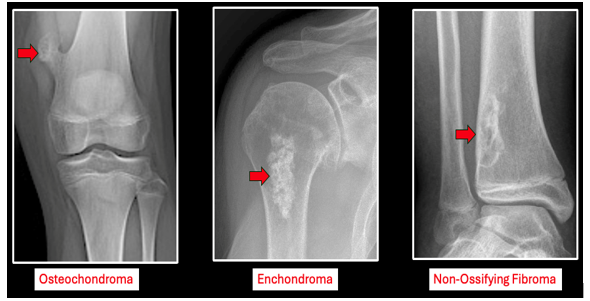
Benign bone and soft tissue tumors are more common than many people realize. Most people with these tumors have no symptoms, meaning they may not feel pain or notice any changes. Because of this, the exact number of people who have these tumors is not known, but they are believed to be fairly common. Some of the most common benign bone tumors include osteochondromas, enchondromas, and non-ossifying fibromas (Figure 1). These tumors are often found by chance when an X-ray is taken for another reason, such as an injury. The most common benign soft tissue tumor is a lipoma, which is a slow-growing lump made up of fatty tissue.
Figure 1. Radiographic imaging of the most common benign bone tumors encountered.
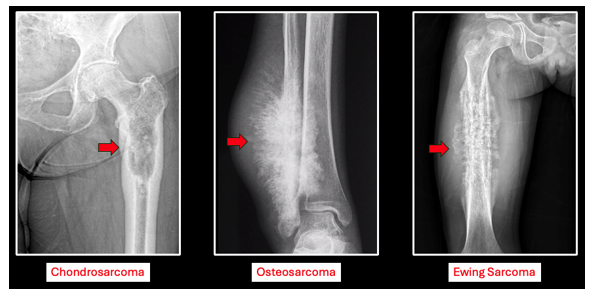
Malignant bone and soft tissue tumors, also called sarcomas, are rare cancers that make up less than 1% of all new cancer diagnoses each year. In the United States, about 15,000 people are diagnosed with a sarcoma each year, including about 3,000 bone sarcomas and 12,000 soft tissue sarcomas. Because sarcomas are uncommon and can be complex to diagnose and treat, it is important for patients to be evaluated by a specialist with experience in musculoskeletal tumors, such as a fellowship-trained orthopaedic oncologist or sarcoma care team. The most common bone sarcomas include chondrosarcoma, osteosarcoma, and Ewing sarcoma (Figure 2). Common soft tissue sarcomas include undifferentiated pleomorphic sarcoma (UPS), liposarcoma, and leiomyosarcoma.
Figure 2. Radiographic imaging of the most common malignant bone sarcomas encountered.
Clinical Presentation
Benign tumors are non-cancerous growths made up of cells that behave much like normal tissue. They usually grow slowly over months or even years, stay in one area, and do not spread to other parts of the body. In rare cases, some benign tumors may behave differently. Benign soft tissue tumors are often first noticed as a slow-growing lump that may feel soft or movable under the skin and usually does not cause pain. Many are small and do not interfere with daily activities, although some people may notice them because of their appearance or location. Most benign bone tumors do not cause any symptoms and are often found by chance when an X-ray is taken for another reason, such as an injury.
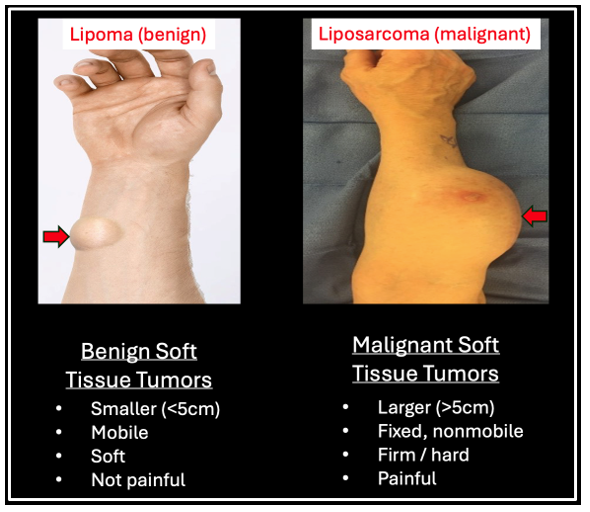
Malignant bone and soft tissue tumors, also called sarcomas, are cancerous tumors made up of abnormal cells that grow out of control. These tumors often grow more quickly than benign tumors, sometimes over weeks to months. Soft tissue sarcomas may appear as a lump that is growing, feels firm, is deeper in the tissue, or sometimes causes pain or affects daily activities. Some sarcomas may spread to other parts of the body, most commonly the lungs or other bones. It can be difficult to tell the difference between a benign and malignant mass based on symptoms alone. Because of this, any soft tissue mass that is growing, feels concerning, or is larger than about 5 centimeters (about 2 inches, or roughly the size of a golf ball) should be evaluated by a specialist with experience in sarcoma care for further testing and treatment if needed.
Table 1. General Features of Benign and Malignant Tumors (Individual Tumors May Differ).
|
Characteristics |
Benign |
Malignant |
|
Histology |
Mature cells |
Atypical, pleomorphic cells |
|
Growth Rare |
Slow growing (months-years) |
Fast growing (weeks-months) |
|
Borders |
Well-defined tumors |
Poorly defined tumors |
|
Local Invasion |
Does NOT invade local tissue |
Does invade local tissue |
|
Risk for Spread |
Very low risk |
Higher risk |
|
Management |
Observation or local resection |
Wide excision ± chemotherapy/radiation |
Figure 3. Comparison between the most common benign soft tissue tumor (i.e., lipoma) to its malignant counterpart (i.e., liposarcoma).
Diagnostic Imaging
There are several imaging tests that doctors may use when evaluating a bone or soft tissue tumor. No single test tells the whole story, so imaging results are always interpreted together with your symptoms, medical history, and physical examination. Because bone and soft tissue tumors can sometimes be complex, patients with concerning findings may be referred to a specialist with experience in musculoskeletal tumors, such as an oncology orthopedist, to help guide the evaluation and treatment plan.
Some of the most common tests include:
Plain Radiographs (X-rays):
X-rays are often the first imaging test performed and may be obtained during your office visit. They help your doctor see the location of a tumor, look for changes in the bone, identify areas of mineralization or calcification, and gather other important information. X-rays often help determine whether additional imaging is needed.
Computed Tomography (CT-scan):
A CT scan uses X-rays and computer technology to create detailed cross-sectional images of the body. CT scans are especially helpful for evaluating bone in greater detail and may provide additional information about certain tumors. They can also show nearby soft tissues, such as muscle and fat.
Magnetic Resonance Imaging (MRI):
MRI uses magnets and radio waves to create detailed images of soft tissues, including muscles, tendons, nerves, and bone marrow. MRI can help your doctor better understand a tumor’s size, location, and relationship to nearby structures. This information can help guide diagnosis, determine whether a biopsy is needed, and assist with treatment planning. In some cases, repeat MRI scans may be used to monitor a tumor over time or evaluate response to treatment.
Biopsy
A biopsy is a procedure in which a small sample of tissue is removed from the tumor and examined by a pathologist to determine the exact diagnosis. Not every tumor requires a biopsy. Some benign bone and soft tissue tumors can be diagnosed based on imaging and clinical evaluation alone. However, if imaging or clinical findings suggest that a tumor may be malignant, a biopsy is often needed to confirm the diagnosis and help guide the most appropriate treatment, which may include surgery, chemotherapy, radiation therapy, or a combination of treatments.
Management
Treatment for bone and soft tissue tumors depends on the type of tumor, its location, whether it is causing symptoms, and the patient’s individual goals. Many benign tumors do not require treatment and can be safely monitored over time with follow-up visits or imaging. If a benign tumor causes pain, continues to grow, affects nearby structures, or impacts daily activities or quality of life, surgery may be recommended to remove it.
Malignant tumors (sarcomas) usually require more specialized treatment. Surgery is often an important part of treatment and may be combined with systemic therapy, radiation therapy, or both, depending on the specific type of cancer. The treatment plan is tailored to each patient based on the tumor type, location, stage, overall health, and personal treatment goals.
Prognosis
Benign bone and soft tissue tumors usually have an excellent outlook and are often not dangerous. Many never require treatment. If a benign tumor is removed, it usually does not come back, although some types can return and may need additional treatment or follow-up. Benign tumors almost never spread to other parts of the body and are typically not life-threatening.
Malignant (cancerous) bone and soft tissue tumors are more serious, but treatment options continue to improve. The outlook can vary from person to person and depends on several factors, including the specific type of tumor, its size and location, whether it has spread, the patient’s overall health, and how the tumor responds to treatment. Specialists in bone and soft tissue tumors, such as orthopaedic oncologists and sarcoma care teams, can help guide patients through diagnosis, treatment, and what to expect moving forward.
More Information:
- https://www.msts.org/for-patients
- https://www.cancer.org/cancer/types/bone-cancer.html
- https://www.cancer.org/cancer/types/soft-tissue-sarcoma.html
This is not intended as a substitute for professional medical advice and does not provide advice on treatments or conditions for individual patients. All health and treatment decisions must be made in consultation with your physician(s), utilizing your specific medical information. Inclusion in this is not a recommendation of any product, treatment, physician or hospital.